How we help
From first idea to practical use.
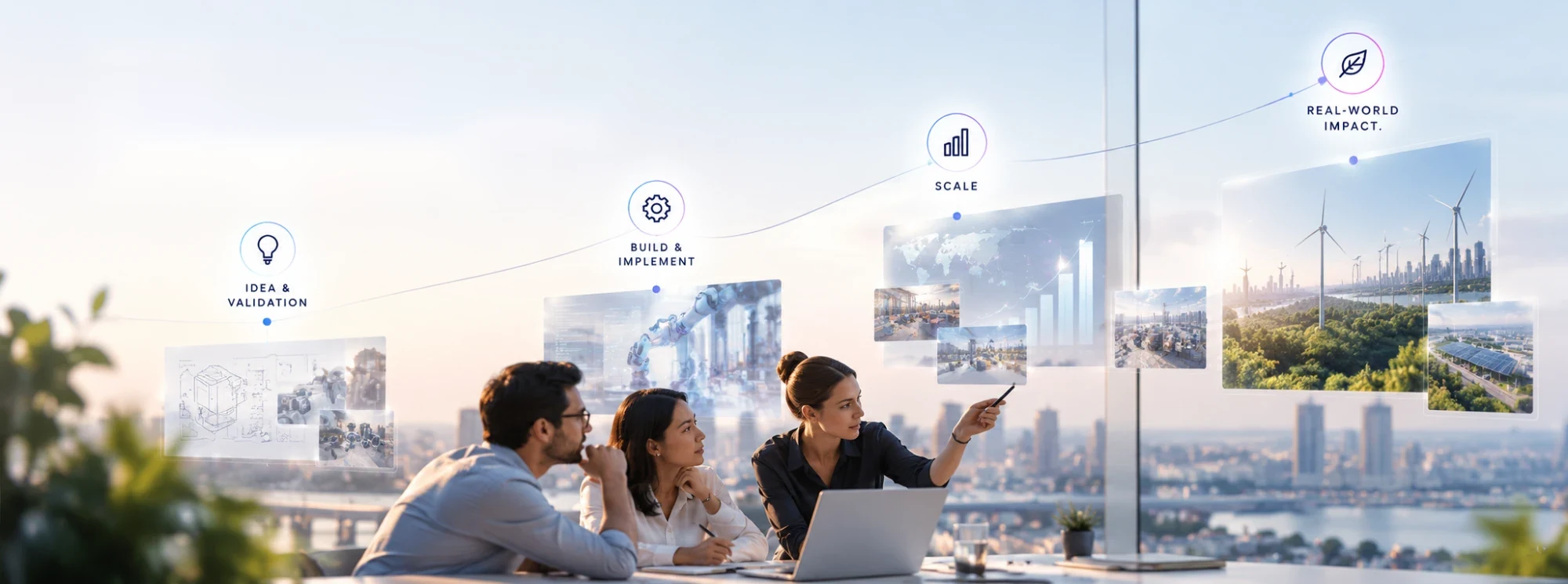
Our work follows four stages.
- 01
Idea & validation
Start with the problem. We explore the user need, business opportunity, available data and technical feasibility before deciding what should be built.
The goal: Know what is worth testing.
- 02
Build & implement
Turn the idea into something real. We define the technical approach, build the first solution and test it against clear objectives. This can include prototypes, AI proof-of-concepts, MVPs, integrations and production solutions.
The goal: Make it work in practice.
- 03
Scale
Build on what works. Once the solution has been validated, we strengthen the technology, product and operating model so it can support more users, customers and environments.
The goal: Move from a successful implementation to something repeatable.
- 04
Real-world impact
Technology only matters when it is used. We look at what actually changes for the customer, user or operation: better decisions, less manual work, new capabilities, improved quality, and new products or businesses.
The goal: Create value that can be seen and measured.
What we build
Technology for real problems.
We work across software and applied AI, and choose the technology to fit the problem.
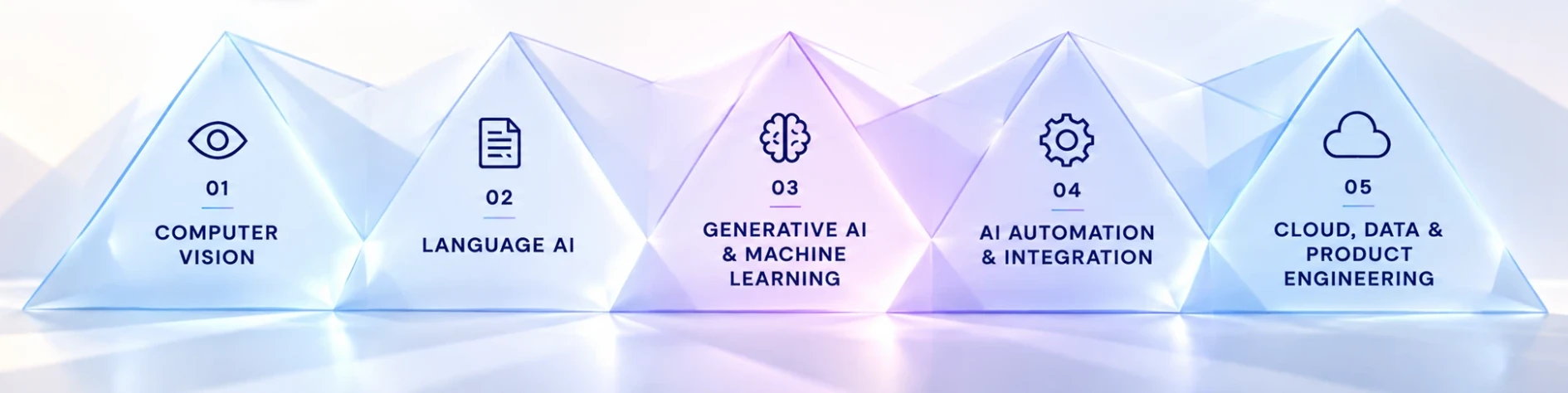
Computer vision
Detection, inspection, tracking and measurement from images and video.
Language AI
Document understanding, knowledge retrieval, search, classification and language-driven workflows.
Generative AI & machine learning
Assistants, knowledge systems and AI-enabled workflows.
Prediction, classification, optimization and decision support using operational data.
AI automation & integration
Connecting models with software, data, sensors and workflows, with human-in-the-loop design where needed.
Cloud, data & product engineering
Prototypes, PoCs, MVPs and production-ready systems.
Architecture, CTO-level guidance, implementation and scaling support.
Have a problem worth solving?
Tell us what you are trying to change.