24 November 2026
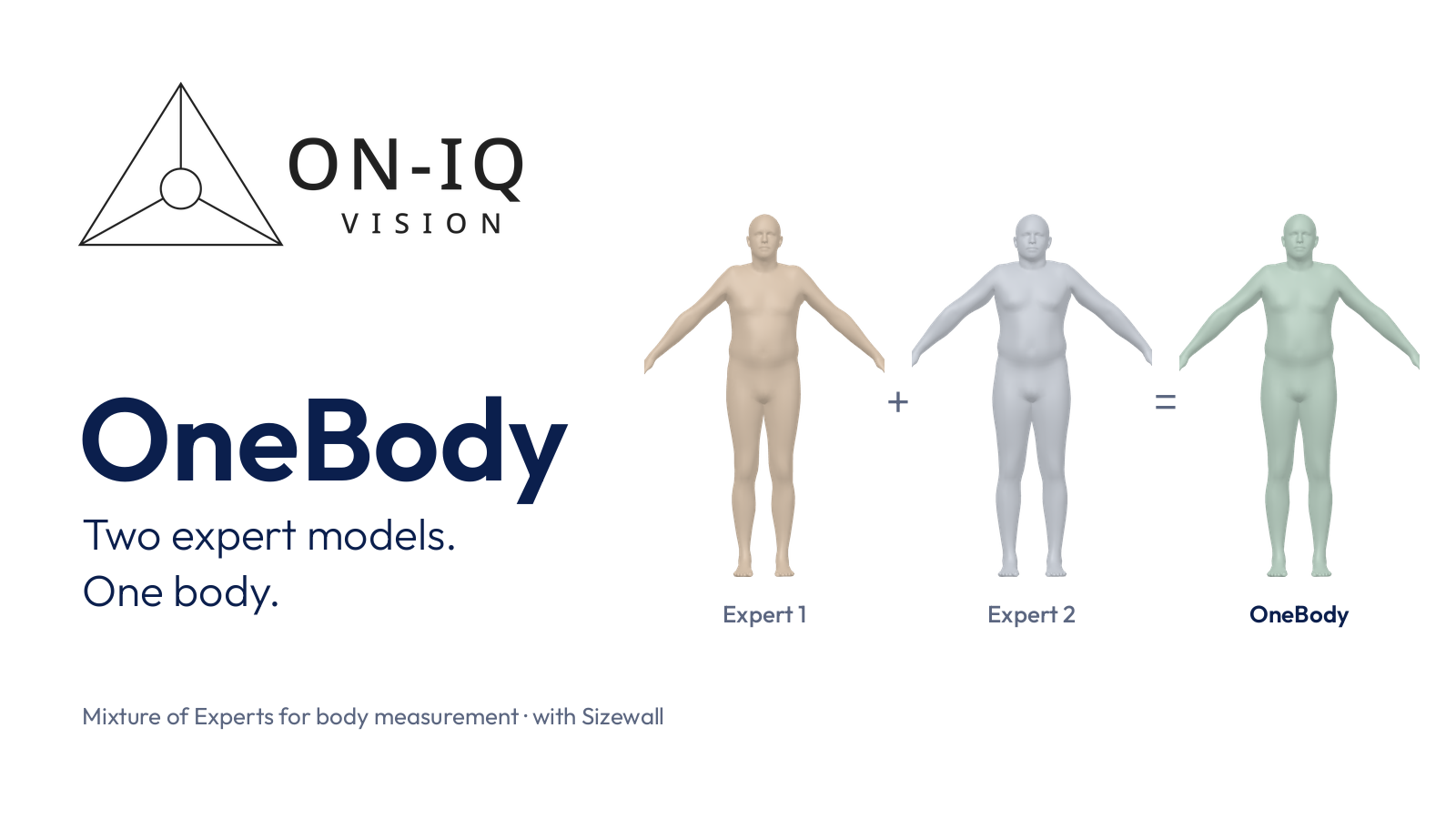
OneBody: Two expert models. One body.
Engineering more reliable AI-powered body measurements.
Building an AI model that performs well in a controlled environment is one challenge. Making it deliver consistent results in everyday use is another.
Through our development work with Sizewall, we have been addressing this challenge within AI-powered 3D body reconstruction and body measurement.
The result is OneBody, a Mixture of Experts approach that combines the strengths of two AI models to improve measurement repeatability and make meaningful changes easier to identify over time.
Beyond accuracy: the importance of repeatability
Sizewall's original model, developed in 2023, uses a custom deep neural network to reconstruct a full 3D body from two smartphone images.
The model demonstrated promising accuracy in laboratory tests and practical applications. However, everyday use revealed an important challenge: the same person could receive noticeably different measurements depending on smartphone positioning and image capture.
When developing technology for health coaching and progress tracking, accuracy alone is not enough.
We also need to understand how much a measurement varies when the body itself has not changed.
Even traditional tape measurements introduce uncertainty. Self-administered measurements can differ considerably from those taken by trained professionals.
This makes repeatability an essential part of evaluating body measurement technology.
Two experts, one body
Since 2023, we have developed alternative models using public body-shape research, tens of thousands of synthetic 3D bodies and testing against real scans captured through the Sizewall application.
The newer models use four views of the body instead of two.
While the newer approach demonstrated improved repeatability, the original model still performed better on certain measurements.
Rather than replacing the original model, we explored how the two could complement each other.
OneBody runs both models on the same set of captured images. Each independently estimates the body's shape using STAR, an open 3D body model.
The estimates are averaged into one unified body, scaled to the person's height and used to calculate body measurements.
The application captures five images per view, producing ten body-shape estimates that contribute to the final result.
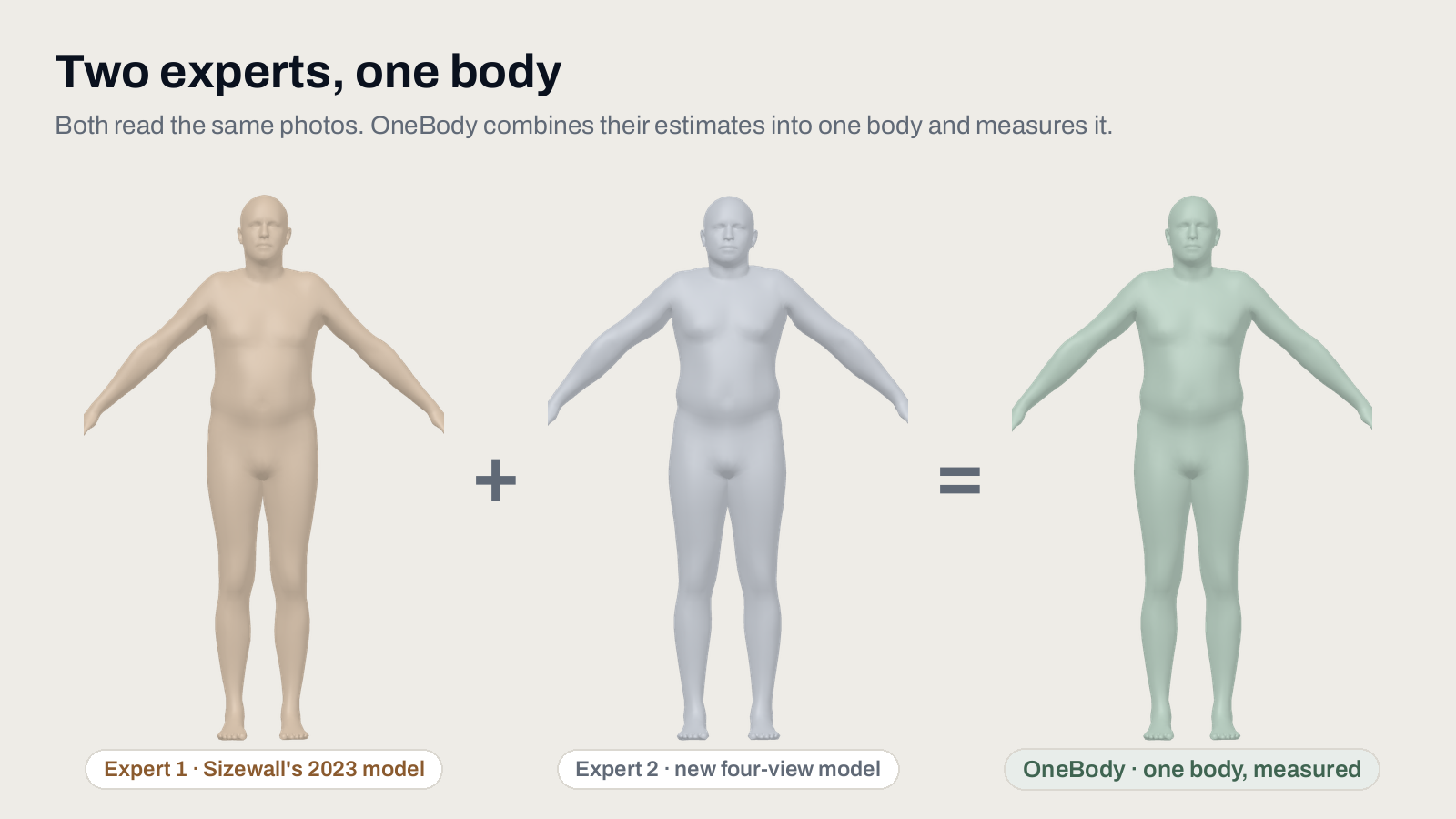
In our initial evaluation, the combination performed better than either individual model on almost every measurement we tracked.
Measuring the improvement
In an initial repeatability test involving one participant and twelve scans, the standard deviation of waist measurements decreased from 5.0 cm to 2.5 cm.
This represents a 50% reduction in measurement variability compared with the previous Sizewall model.
For context, published manual measurement figures provide the following comparison:
| Measurement method | Standard deviation |
|---|---|
| Unguided tape measurement at home | 5.3 cm |
| Previous Sizewall model | 5.0 cm |
| OneBody | 2.5 cm |
| Careful manual measurement | 1.6 cm |
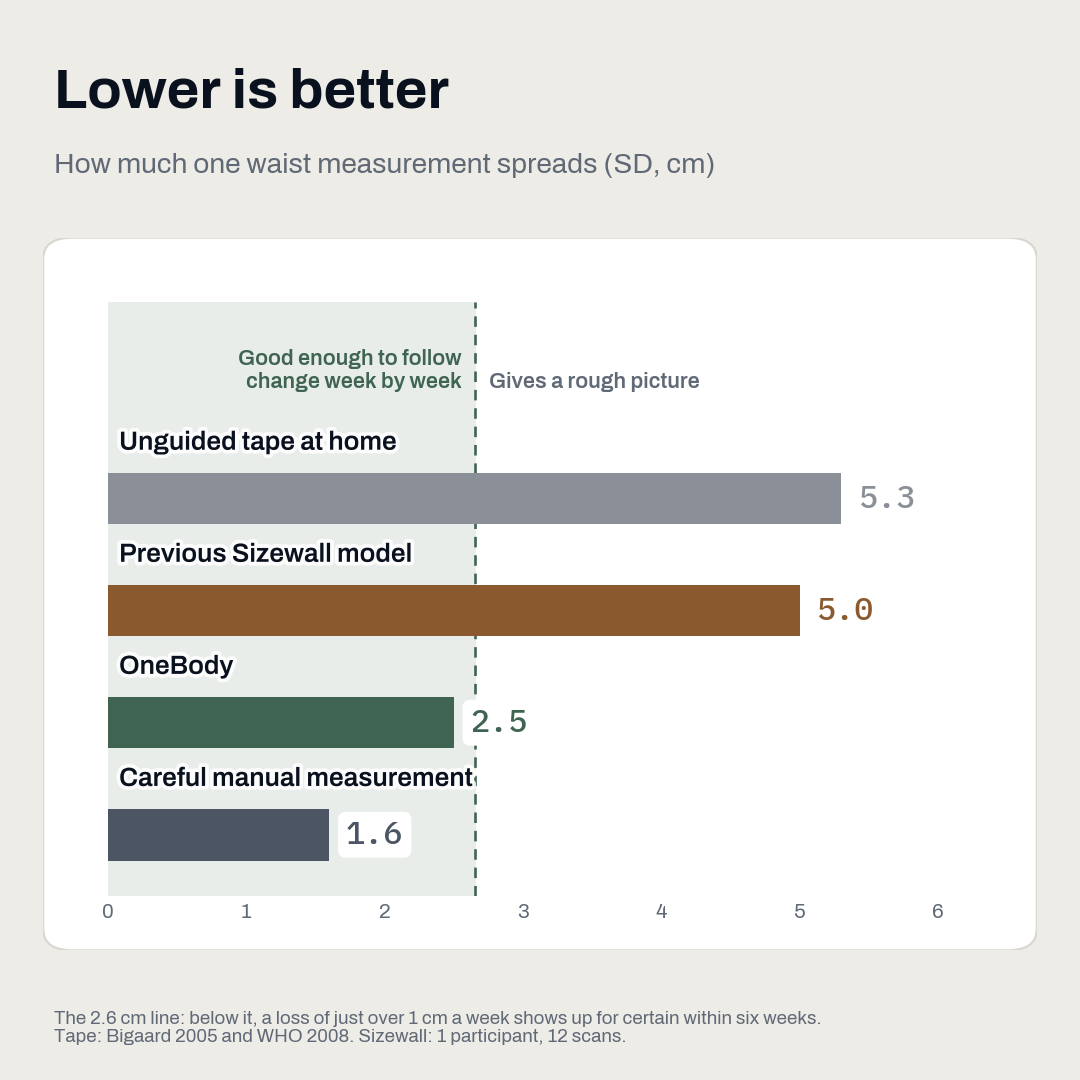
These preliminary results are encouraging, but broader validation is necessary.
A study involving 40 participants, each completing five scans, is currently underway.
From technical improvement to practical value
What could improved repeatability mean for a health coach or personal trainer?
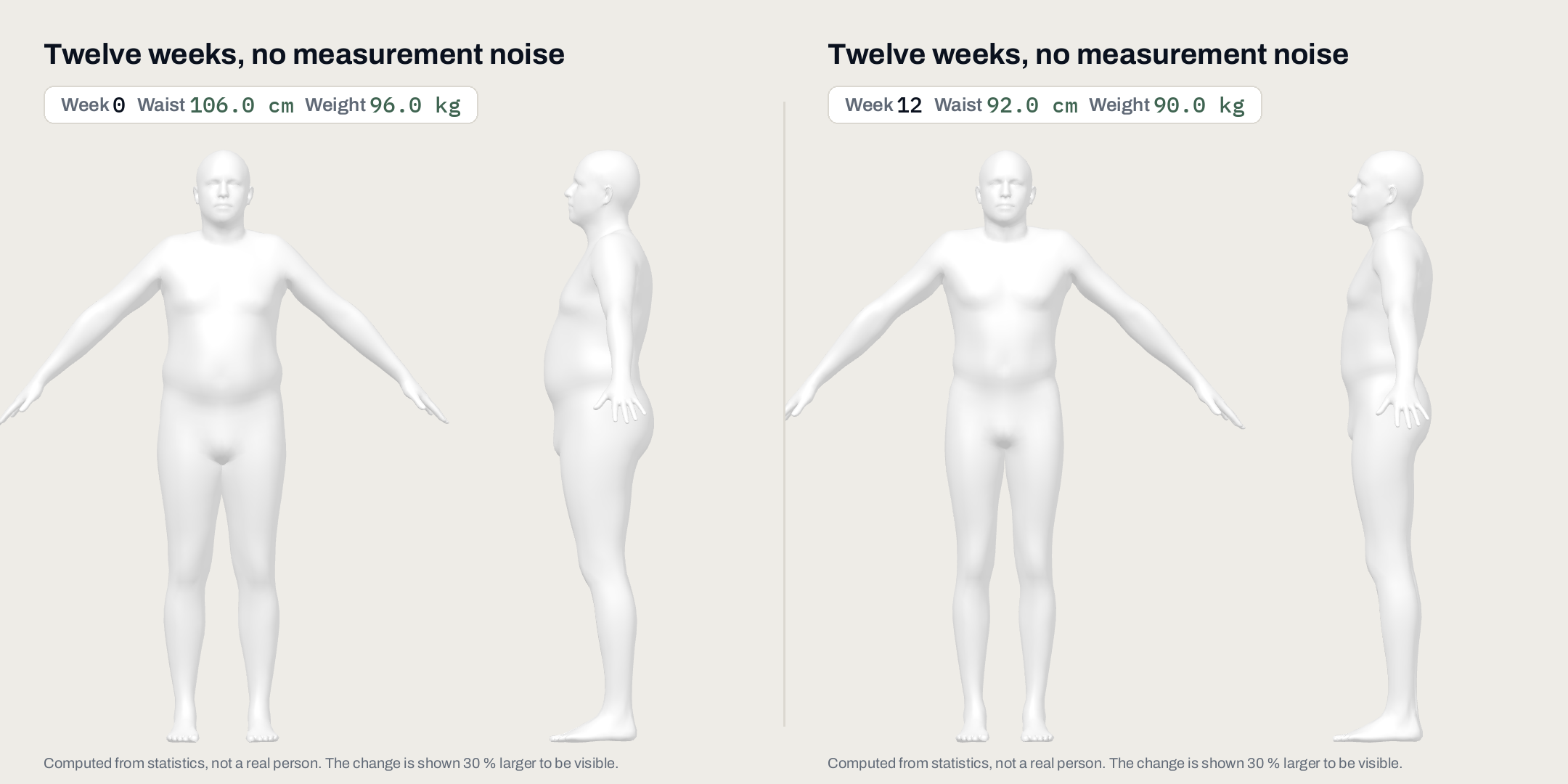
To explore this, we created a simulated twelve-week scenario in which a person's waist circumference decreases from 106 cm to 92 cm, while their weight decreases from 96 kg to 90 kg.
Using the measurement variability figures, we calculated how long each method would take to identify the downward trend with less than a 1% probability of identifying the wrong direction.
In this simulated scenario, OneBody identifies the trend after six weeks, compared with ten weeks using the previous Sizewall model and eleven weeks using unguided tape measurements at home.
A careful manual measurer identifies the trend after five weeks.
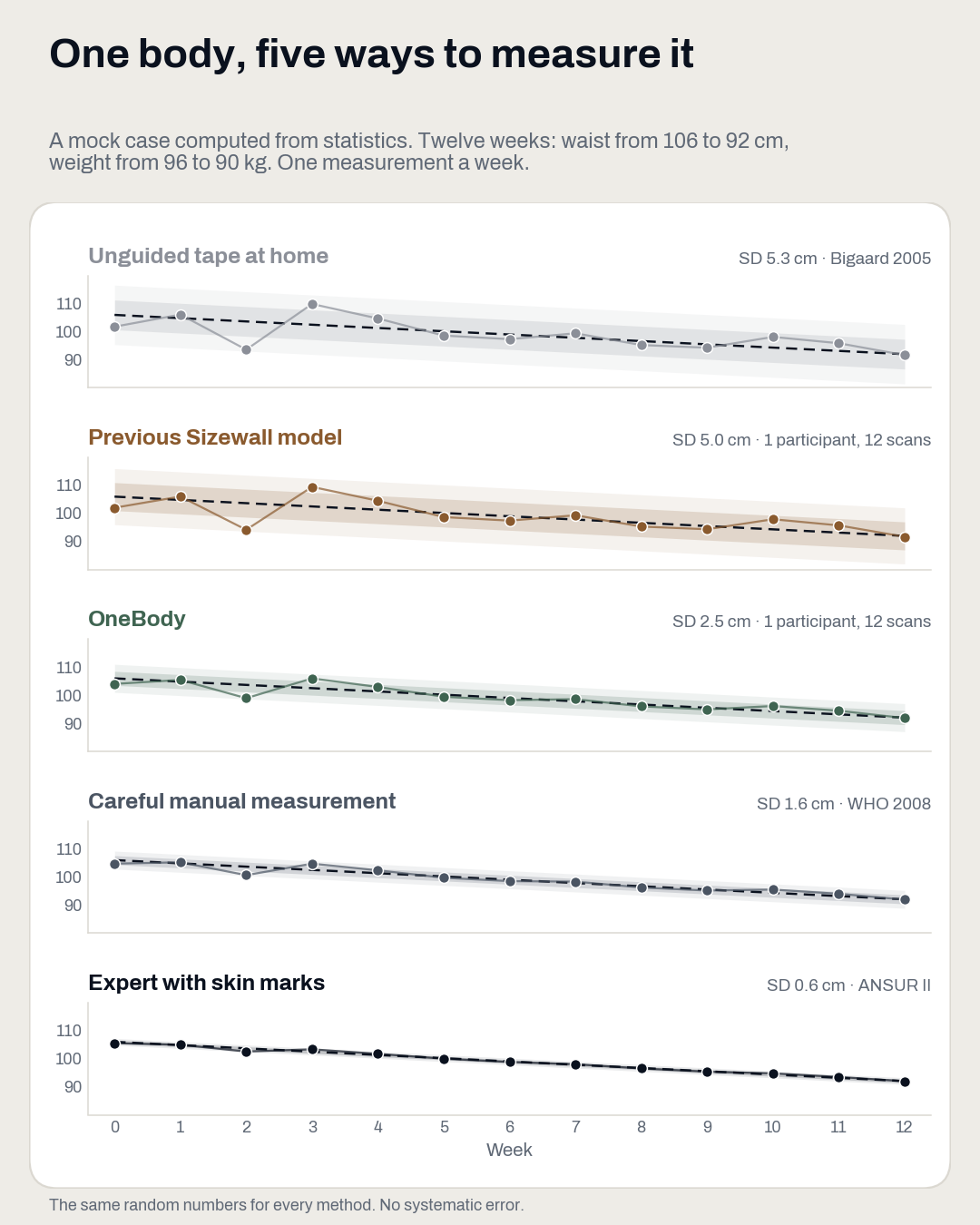
The simulation illustrates how more consistent measurements could help coaches recognise meaningful changes earlier.
It is a statistical illustration, not an actual patient case or a demonstrated clinical outcome.
Building on established research
OneBody combines custom model development with established open technologies:
- STAR: Statistical 3D body modelling.
- SAM2, through rembg: Image segmentation to separate the person from the background.
- HRNet: Body keypoint detection.
Our engineering approach is to understand where existing technologies provide value, where custom development is necessary and how different approaches can work together.
AI in Practice: continuous development
OneBody reflects our approach to building technology at ON-IQ Vision.
Better AI does not necessarily mean replacing existing models or introducing more complexity.
Sometimes, the most valuable improvement comes from understanding the strengths and limitations of what we have already built.
Understanding the problem, challenging assumptions, testing, measuring and continuously improving are fundamental parts of our development process.
As a tech partner, we work alongside founders and businesses to turn technical possibilities into solutions that create practical value.
OneBody is now integrated into Sizewall Coach, bringing this development into an application designed for coaches and personal trainers.
ON-IQ Vision – Tech partner and operational investor. We co-build with you.
Research and validation notes: Manual measurement comparisons are based on Bigaard (2005), WHO (2008) and ANSUR II. Initial Sizewall repeatability results are based on one participant and twelve scans. The twelve-week coaching example is a statistical simulation and does not represent an actual individual.